
If you want to get more plumbing sales, here's an uncomfortable truth: you don’t lose the most revenue to a competitor with better marketing. Most revenue is lost between a lead coming in and a job getting booked.
The U.S. plumbing industry is on track to hit $191.4 billion in revenue in 2026. Homeowners and commercial clients are searching and booking every day. If revenue feels stuck, the problem usually isn't awareness. It's what happens after the phone rings.
Why Plumbing Sales Don’t Come From Lead Generation Alone
Lead generation is only as effective as your follow-up processes. Most people don’t start a plumbing business to be a salesperson. Unfortunately, many companies lack proper systems, processes, and sales training. Research shows that 63.5% of B2B companies never follow up on inbound inquiries at all.
Even when your team talks to a prospect, they might not follow through. According to an Invoca analysis of 60 million phone calls, only 35% of agents on inbound calls actually ask for the sale.
If your estimates are going cold, it’s rarely because the customer chose a competitor on price. Someone else called them back first. The fastest-growing businesses are doing a better job of capturing existing demand. They don’t need to chase leads.
10 Proven Ways to Get More Plumbing Sales
1. Show Up Where Local Customers Already Search for Plumbers
Your Google Business Profile (GBP) is your most important asset. Businesses in the local map pack receive 126% more traffic than lower-ranked businesses. If your GBP has incomplete hours, outdated service areas, or no recent reviews, you’re losing jobs to competitors with a complete profile.
The operational fix: An easy way to get plumbing leads is auditing your GBP. Confirm service area, hours, and phone number. Don’t just request reviews from recent plumbing customers; respond to each one. BrightLocal finds that 80% of consumers will use businesses that reply to all reviews, versus 47% for businesses that respond only to negative reviews.
2. Turn Positive Reviews Into a Sales Channel
Positive reviews are one of the fastest tools for building trust with plumbing customers before they connect with you. Over 90% of potential customers check reviews before calling. Expect that trend to continue.
The operational fix: Build review requests into your post-job process. Have technicians ask for a review in person, then follow up with an automated text. Consistent outreach pays off over time.
3. Make Your Website Convert Urgent Visitors Into Booked Jobs
When a homeowner has a burst pipe, they aren’t comparison shopping. If your business doesn’t pick up the phone or lacks prompt customer service, they’ll move on to someone else. Likewise, if your website doesn’t make it easy for home services consumers to get a quote or reach a human, that’s missing revenue that you’ll never know you lost.
The operational fix: Websites for plumbers should prominently offer a click-to-call option above the fold. Don’t route calls to hold music or voicemail. Make sure your website is mobile-friendly.
4. Train Your Team to Offer Options Instead of a One-Size-Fits-All Fix
Offering only one quote forces customers to say yes or no. But when your technician presents a menu of basic repairs, a midtier fix, and full replacement — each with clear tradeoffs — customers can confidently choose among defined outcomes. By offering good/better/best tiered pricing, you increase the odds of a successful close. Additionally, offering financing removes the budget barrier that shrinks a $4,800 repipe into a patch job.
The operational fix: Define three options for your most common job types, including drain clearing, water-heater replacements, and pipe repairs. You can quickly roleplay a three-option presentation without a formal training program.
5. Increase Average Ticket Size by Looking Beyond the Immediate Repair
When your technician is inside the home, they have a rare opportunity to notice and surface other issues. A plumber diagnosing a plumbing issue can offer a water filtration upsell, inspect supply lines, or flag a pressure regulator nearing its end of life. Existing service plan holders represent some of the highest long-term value in most plumbing businesses.
The operational fix: Build a short diagnostic checklist into your service workflow. After completing the primary job, check adjacent systems — water pressure, visible corrosion, appliance age — and present your findings before leaving. Consistent execution across your team compounds over time.
6. Respond Faster Than Competitors When New Leads Come In
In emergency plumbing, the customer is calling multiple plumbers in short order. The first to answer often gets the job. Companies taking 60+ minutes to respond are 74% more likely to lose leads than companies responding within 15 minutes.
Speed is a system design problem. If calls route to voicemail after business hours, or website leads sit in an inbox until morning, that’s enough to lose the job.
The operational fix: Design processes that route leads to the right person in real time, whether they are calling in or on your website. Set up a 24/7 answering service, or see how using AI in plumbing can improve lead-response times.
7. Follow Up on Estimates Before Customers Hire Someone Else
Silence isn’t rejection. Customers who don’t immediately respond to a quote haven’t necessarily hired someone else. They’re often waiting for your follow-up. Since 63.5% of plumbing companies never follow up, any communication cadence puts you ahead of the pack.
The operational fix: Set the stage by calling or texting within 24 hours of the estimate. Follow-up after 72 hours, along with a final attempt after seven days. This process will recover most quotes that would otherwise go cold. Be direct in assigning ownership — if the process lives in someone’s head, it will break.
8. Use Past Customers to Generate Repeat Work and Referrals
Most plumbing professionals underinvest in winning additional business from their existing customers. Maintenance agreements create a cadence and increase customer satisfaction. When they’re already paying $15 to $25 per month for annual inspections, priority scheduling, and repair discounts, they have a built-in reason to call you first — and recommend others to your business.
The operational fix: A clear follow-up sequence keeps your plumbing business visible even without a membership program. For example, send a text 30 days after replacing a water heater, or offer seasonal reminders about protecting pipes. These touchpoints wake up dormant customers and generate repeat revenue.
9. Focus Your Marketing Budget on Channels That Produce Booked Revenue
Paid ads require fresh spending to remain effective. Other factors, such as strong local SEO and a Google Map presence, compound over time, generating high-intent traffic without ongoing spend. 54% of customers choose a plumbing service within four hours of beginning their search. What matters is you showing up when they go looking.
The operational fix: Optimize your Google listings and collect positive reviews, then invest in local SEO. Only then should you layer in paid search for coverage.
Related: Our plumbing advertising examples show what actually performs in this category.
10. Track the Numbers That Tell You Where Sales Are Leaking
Five key metrics will tell you exactly where revenue is leaking:
- Revenue closed
- Booking rate
- Paying customer rate
- Customer acquisition cost
- Average ticket size
Is your booking rate low? The problem is call handling or speed-to-lead. Your paying customer rate reveals how well you’re following up on open estimates. Flat average tickets, meanwhile, require better presentation of options at the job level.
The operational fix: Customer lifetime value ties everything together. A maintenance plan customer who stays five years and replaces their water heater with you is worth five to 10 times a one-time service call. Track this metric.
What to Fix First If Your Plumbing Sales Feel Stuck
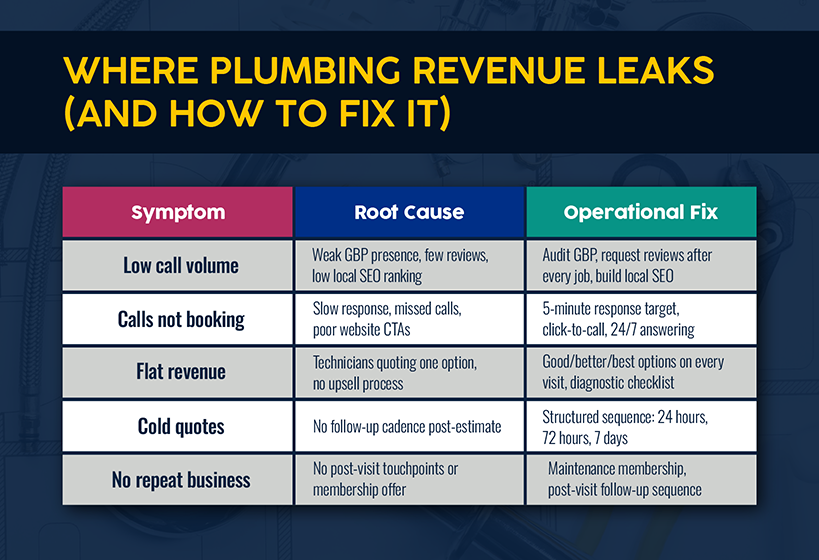
Here are five initial steps to get more plumbing sales, depending on your situation:
- Calls are low: Focus on GBP optimization, review solicitation, and local SEO.
- Calls come in but don’t book: Fix call handling, speed-to-lead, and website conversion. CTAs go straight to a live line, even after hours.
- Jobs get booked, but revenue is flat: Implement option-based selling and a technician diagnostic checklist. Make financing available on larger jobs.
- Quotes go cold: Build a follow-up sequence at 24 hours, 72 hours, and one week. Assign ownership.
- One-time jobs don’t repeat: Launch a maintenance membership, add post-visit follow-up sequences, and create a simple referral mechanism.
How Software and Systems Help Plumbers Sell More Consistently
Missed follow-up, slow lead response, and cold estimates aren’t behavioral problems — they’re system failures. No amount of motivation can fill those gaps in your plumbing service model.
Simpro® is built for trade businesses running this complexity. More than 24,000 businesses use it to manage quoting, scheduling, dispatch, customer history, and follow-up in one connected system. Businesses report up to 25% revenue increases and 30% productivity gains, with estimates running 10x faster than manual processes.
Build a Plumbing Sales System
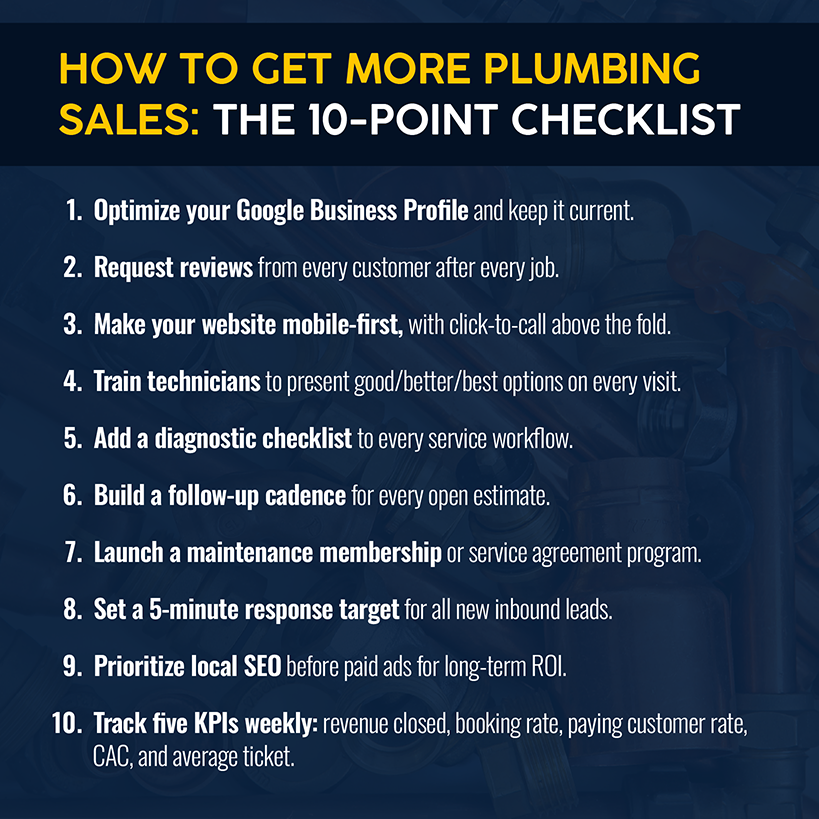
Your future customers are already out there. So is the search volume and the potential for referrals. The plumbing businesses consistently capturing this revenue are executing at a high level and not leaving money on the table.
If you’re looking to improve, start where your biggest leak is. Optimize your online presence. Build the necessary processes to respond to calls within five minutes. Train technicians to present options. Follow up on every open estimate. Create a post-visit sequence for completed jobs.
Each of these moves closes revenue without resorting to special offers. If you’re ready to put a repeatable system behind them, schedule a demo to see how Simpro helps plumbing businesses turn operational consistency into predictable revenue growth.
Frequently Asked Questions: How to Get More Plumbing Sales
How can plumbers get more customers?
Start with your Google Business Profile (GBP). Optimizing this listing with accurate service areas and recent reviews is one of the easiest wins available to plumbing businesses. Pair this with a consistent review-collection process, and inbound volume will follow.
What’s the best marketing channel for plumbers?
Multiple channels working together will generate leads you can convert. GDP and local SEO are the foundation — free or low-cost, and built on existing demand. The goal is to own as much of the local search results page as possible. Paid search fills the gaps.
How fast should plumbers follow up on estimates?
The benchmark is within five minutes of a new inquiry. The longer you take, the more likely that your competitor will get the call and close the deal. For estimates, respond within 24 hours, at the 72-hour mark, and after one week.
How do plumbing companies increase average ticket size?
Present good/better/best tiered pricing during every visit, rather than a single quote. Empower technicians with a diagnostic checklist so they can propose additional repairs and upsell opportunities. Remember: Ticket growth comes from legitimate service recommendations, not pressure.


 Back to top