
The plumbing trends shaping 2026 are easy to summarize, but harder to act on. The plumbing market sits at $191.4 billion, and the spread between what well-run plumbing businesses earn and what everyone else earns is getting wider.
The trends in plumbing industry operations right now are as follows: Scheduling pressure, margin compression, a thinning labor pool, and customers who expect digital everything.
The plumbing industry trends in 2026 show up in your schedule and P&L. Here's what's driving each one and what contractors should do about it.
What's Changing in the Plumbing Industry in 2026?
The plumbing sector is operating under high demand while simultaneously facing a labor shortage. That's a combination that rewards businesses running tight, efficient operations. A projected shortage of 550,000 plumbers is already showing up in scheduling constraints, as operators turn down work because they lack the capacity.
Demand is strong, labor is scarce, and customers expect more. Not to mention, material costs are up over 30% since 2020.
12 Plumbing Trends to Watch in 2026
These trends cover workforce, technology, sustainability, customer behavior, and operations. Most of them overlap. For example, a tech-forward operation better manages the labor shortage. A business with recurring revenue can weather slow seasons. The plumbing business owners who react to those connections are building companies that hold up.
1. Skilled Labor Shortages Continue to Pressure Plumbing Businesses
The United States is projected to be short 550,000 plumbers by 2027, with the Bureau of Labor Statistics forecasting 44,000 new job openings per year through 2034. Meanwhile, 25% of the current workforce is over 55. The retirement wave isn't hypothetical. It's already underway.
Businesses running five to 15 technicians can't hire their way out of this challenge. Experienced plumbing professionals are in short supply, and your existing workers are worth more than ever as market rates adjust. For a service-and-repair plumber, the median wage is $62,970 annually. Meanwhile, trade businesses overall spend over $5.3 billion annually in talent acquisition and training.
Every tech you keep is money you don't spend replacing them.
The operational fix: Use scheduling and dispatch software to get more completed jobs per tech per day without burning them out. When you can't add headcount, you add capacity through better scheduling.
2. Smart Plumbing Technology Becomes More Common
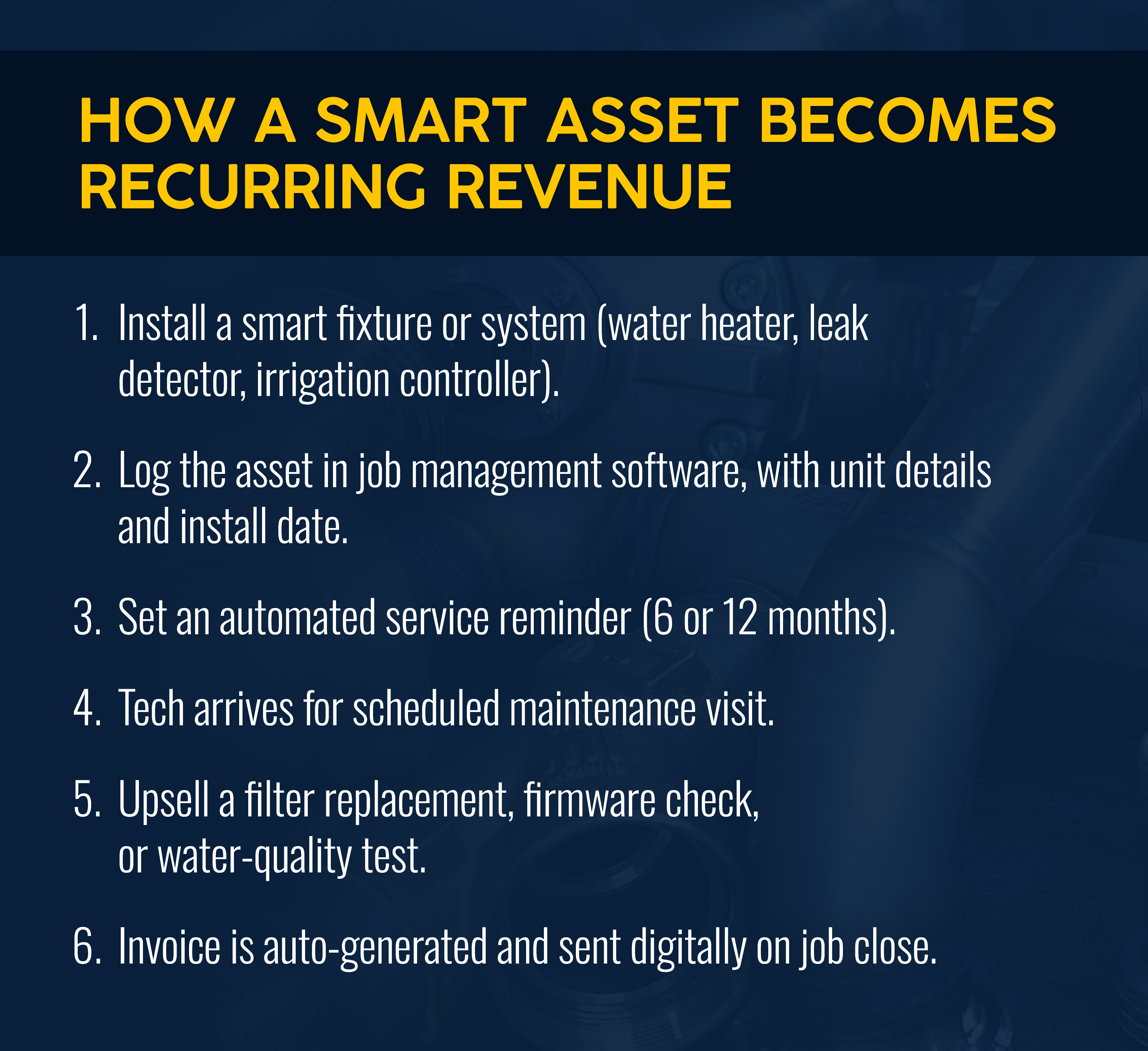
Smart water management is becoming a standard part of residential and commercial plumbing work. The smart bathroom market is projected to grow at a 13.7% compound annual growth rate (CAGR) through 2035, powered by installations of smart toilets, smart faucets, and more.
The advancements aren't just in fixtures. IoT-based leak detection is increasingly expected by homeowners who've seen average insurance claims for water damage approach $14,000.
For contractors, the biggest shift is in the service model. Smart fixtures and connected plumbing systems require ongoing maintenance and firmware-level troubleshooting, which means recurring work must be built into the install.
The operational fix: Start tracking installed smart assets in your job management system. If a customer has a smart water heater or leak-detection system, that unit should be in your records with a scheduled follow-up. That's how you convert a one-time install into a maintenance relationship.
3. Water Conservation Moves From Nice-to-Have to Expected
Residential water leaks waste nearly 900 billion gallons annually. Greywater recycling is growing at a global CAGR of 6.7%, with North America capturing roughly 32% of the market. Combining rainwater harvesting and greywater reuse can reduce potable water demand by 40–60%, which resonates with commercial property owners trying to hit net-zero water targets.
Water use in landscaping is another concern for customers, especially in residential. Smart irrigation controllers can address the estimated 50% waste rate on the 8 billion gallons used each day for landscape watering.
State and local water conservation regulations are tightening, too. The 2024 International Plumbing Code updates include revised greywater and rainwater reuse provisions. That's compliance-motivated work with real volume behind it.
The operational fix: Get trained on the latest water conservation code requirements in your coverage area. When contractors understand which upgrades qualify for EPA WaterSense compliance or Inflation Reduction Act tax credits, they can quote those jobs as advisors, which changes both the conversion rate and the margin.
4. Whole-Home Water Filtration Demand Keeps Growing
Water-quality concerns have accelerated consumer interest in whole-home filtration, point-of-use systems, and inline filters, particularly in markets with aging infrastructure. The margin on a properly quoted filtration install can match or beat a standard service call, especially when paired with a filter change agreement. But most residential techs aren't presenting these options.
The operational fix: Make sure your standard service process includes filtration systems and filter replacements. A tech completing a water heater replacement should be presenting filtration options. If you're using flat-rate pricing, your book should include standard filtration packages at defined margin targets.
Related: Plumbing profit margins: Understand where water-quality upgrades fit in your service-line margin stack.
5. Trenchless Sewer Repair Gains More Attention
Replacing aging U.S. plumbing infrastructure will require more than $1 trillion in investment over two decades. Trenchless methods like pipe lining and pipe bursting can reduce the property disruption of traditional excavation, which matters to homeowners and commercial property managers. These estimates are more complex, which means customers can't easily price-shop the work. The margins hold up better than straight excavation, too.
The operational fix: If you have techs with trenchless certification, make sure that's clearly visible in your quotes and service offerings. If you don't, consider whether your local infrastructure profile justifies the investment. Markets with high repair volume can start recouping ROI within the first few jobs.
6. Aging Infrastructure Creates More Repair and Replacement Work
Aging pipes, fixtures, and fittings are generating consistent repair and replacement volume across residential and commercial work. But not all work generates the same margin.
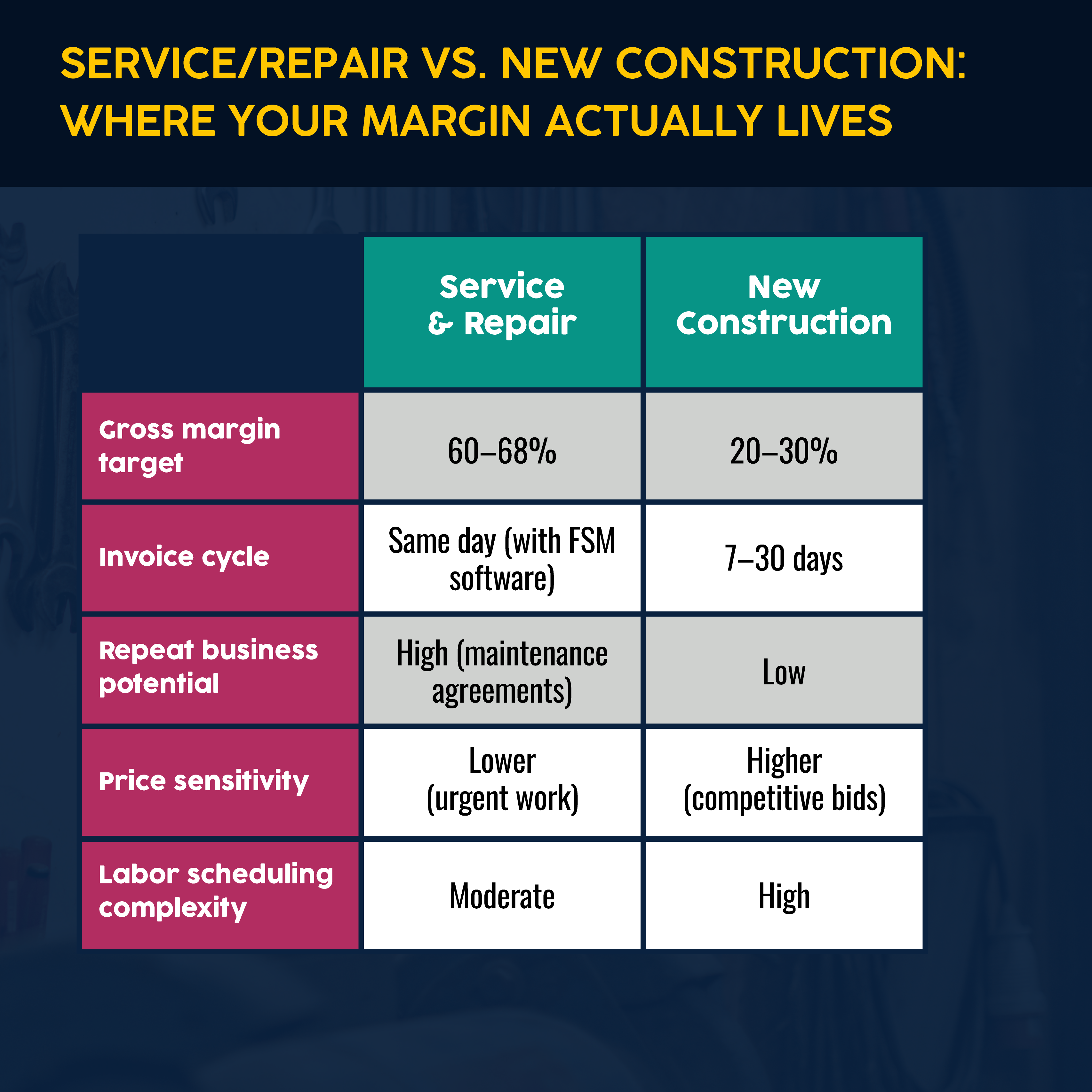
For plumbing businesses running heavy new construction, the margin comparison is concrete: Service and repair targets 60-68% gross margins, while new construction runs 20–30% gross margin. If construction revenue exceeds 30-40% of your total, it's likely pulling your blended numbers down even when the overall revenue looks fine.
The operational fix: Segment your P&L by service line. Track gross margin for service/repair separately from construction and drain work. Most operators who do this for the first time find out their construction jobs are subsidizing their service work, not the other way around.
7. Customer Expectations for Speed and Communication Keep Rising
Most (54%) homeowners research and hire a plumber within four hours, typically choosing the first business with strong online reviews.
A customer with a leaking water heater on a Tuesday morning isn't comparison-shopping. They're calling the first business that looks credible and picks up. Your digital presence and responsiveness are crucial for home services work — and nearly as important as the quality of your work.
The operational fix: Build a systematic post-job review request into your workflow. Automatically sending a text after job completion is the most consistent approach. Reviews codify customers' experiences with your business within hours of a job closing, so your response process needs to be just as fast.
Related: Learn how marketing for plumbers builds the digital presence that converts searches into booked jobs.
8. Plumbing Businesses Put More Focus on Operational Efficiency
You can easily measure the production gap between a well-run plumbing company and one that's poorly managed. If you're falling short, you can often improve your company's operational efficiency without increasing headcount.
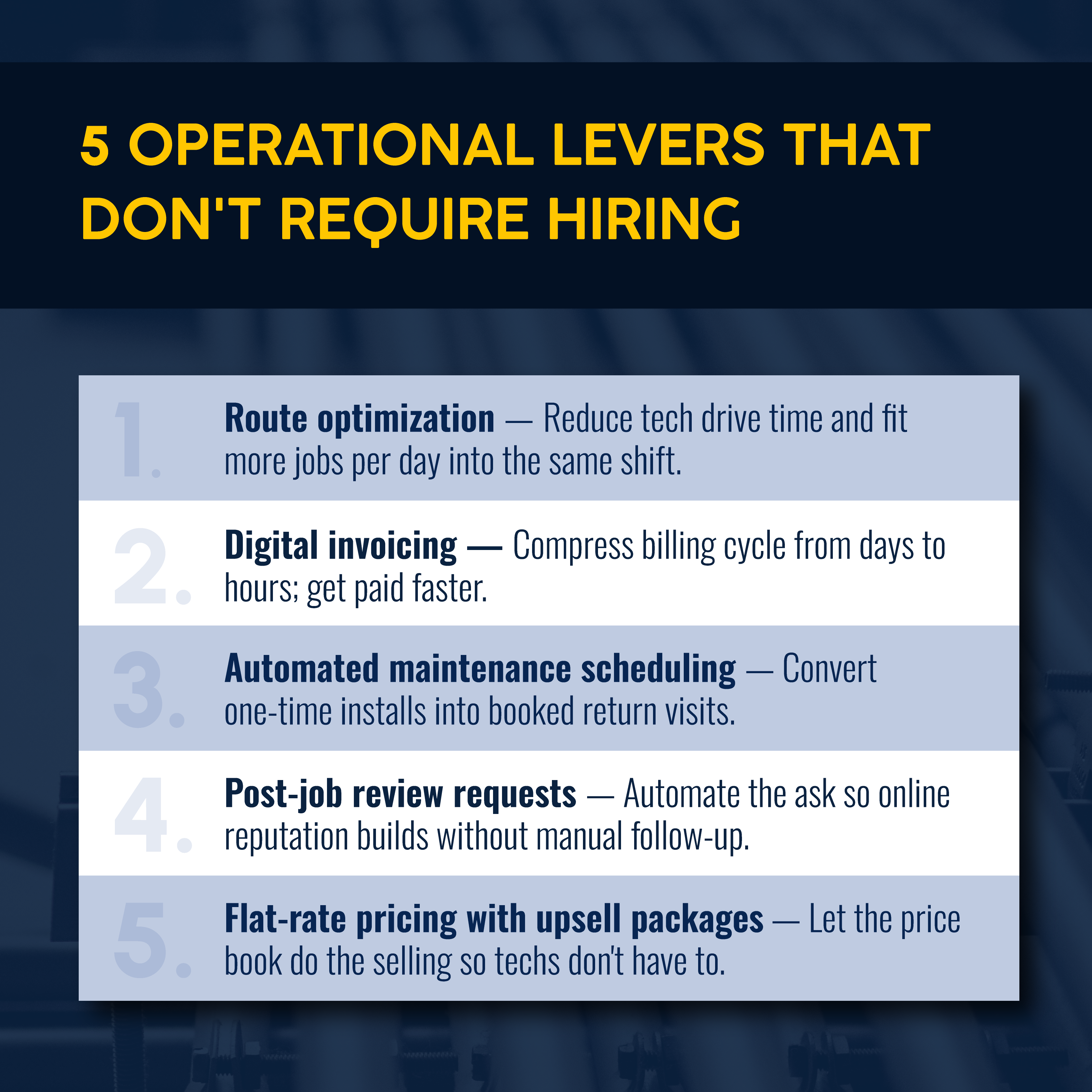
Tequa, a commercial plumbing and mechanical contractor, used field service management (FSM) software to increase service jobs completed per technician by 25%, cut invoice processing from one week to 48 hours, and automate 200 routine maintenance jobs each month. Those gains came from tighter scheduling, mobile invoicing, and automated workflows.
The operational fix: Measure your current dispatch efficiency and invoice cycle time before you optimize. If you don't know your baseline, you can't track improvement. Most businesses that go through this exercise find that the gap is larger than expected.
Related: Plumbing service software for job management: purpose-built for the operational complexity of a growing plumbing business.
9. Preventive Maintenance and Recurring Service Models Become More Valuable
High-performing residential plumbing companies maintain average tickets between $300–$500 through upselling and maintenance memberships. Recurring maintenance programs stabilize revenue in slow seasons and reduce customer acquisition costs, since you're rebooking existing customers rather than constantly marketing for new ones.
Signing 200 home maintenance agreements at $250 per visit, twice per year, creates $100,000 in predictable annual revenue. The economics of preventive maintenance (PM) make sense. What breaks the model is the scheduling and tracking overhead; without software automating both, PM programs create more administrative burden than they're worth at scale.
The operational fix: Automate PM scheduling and invoice generation. A maintenance program that requires a dispatcher to track 200 service windows manually will either collapse under its own weight or stay too small to move the needle. Software-automated maintenance planning is what makes the model viable at volume.
Related: These plumbing management tips can help you develop and structure recurring revenue models for operational sustainability.
10. Digital Payments, Online Booking, and Self-Service Options Grow
Residential and commercial customers increasingly expect digital invoicing and the ability to pay via mobile. Fail to offer those options, and they'll mentally dock your business before the job is even finished — if they even select you. Relying on paper invoices in 2026 reads as disorganized, regardless of the quality of the work.
The operational fix: Enable text-based appointment reminders, digital invoicing, and online payment in a single workflow. If customers have to give a check to your technicians, or you're mailing an invoice afterward, you're adding days to your collection cycle and creating friction that affects repeat business.
11. Regulations and Compliance Become Harder to Ignore
The 2024 IPC updates include revised greywater and rainwater reuse provisions, pipe-sizing changes, and expanded backflow-prevention requirements. State and local water conservation mandates create additional compliance layers.
Commercial contractors, in particular, face a significant administrative burden in documenting inspections, permits, and code compliance.
Digital forms with conditional logic — where the right fields appear based on job type and jurisdiction — reduce the risk of compliance gaps and speed up inspection processes. Paper forms leave too much room for inconsistency, especially in crews with a mix of experience levels.
The operational fix: Standardize compliance documentation in your job management system. Every field tech should be completing the same digital checklist rather than filling out paperwork haphazardly.
12. AI and Automation Start Supporting Plumbing Business Operations
69% of trade business owners already see AI as crucial to optimizing workflows. AI can further reduce the likelihood of energy calls by powering predictive maintenance capabilities. And when you add an FSM platform, 68% of companies report higher productivity.
With the plumbing service software market growing by 11.2% CAGR through 2034, contractors will need to continue adopting AI and automation. But they'll need to be smart about it, as the average trade business already juggles at least five software systems.
For businesses already running field service management (FSM) software, AI-assisted scheduling is the natural next layer. It optimizes tech assignments based on location, job type, skill set, and priority level in real time, rather than relying on dispatcher judgment alone. For businesses still running manual scheduling, the gap is getting wider.
The operational fix: If you're not on a platform with AI scheduling capability, figure out what that gap is costing you. AI-optimized dispatch can make all the difference for a business that's turning down work because of scheduling constraints.
How Plumbing Contractors Can Prepare in 2026
The plumbing industry trends of 2026 aren't hypotheticals. They're already happening. The labor shortage is pushing you toward more output per technician. More output per technician requires better scheduling, faster invoicing, and less time on paper. Smart technology adoption creates recurring maintenance revenue. Recurring revenue makes the business more predictable.
Meanwhile, customer expectations for speed and digital communication require a systematized operational infrastructure instead of organized chaos that depends on individual heroics.
When plumbing businesses establish tight operational foundations, with real-time job costing, automated scheduling, digital invoicing, and maintenance programs built in, they're better positioned to capture demand that's already there.
Related: Growing a plumbing business: Get the operational framework for scaling a trade business without losing control of margins.
Prepare Your Plumbing Business for What's Next
Your schedule is full. Your margins are under pressure. Your best tech just asked about a raise. You're probably already affected by most of these trends in the plumbing industry.
Simpro® is built for the operational complexity of running a plumbing business above the one-person-and-a-truck level. Scheduling and dispatch, real-time job costing, mobile invoicing, automated maintenance scheduling, and business intelligence reporting, all in one platform, purpose-built for trade contractors. More than 24,000 businesses use Simpro to run tighter operations and build more predictable revenue.
Schedule a demo to see how it works for a plumbing business at your scale.


 Back to top