
The HVAC industry statistics for 2026 tell a clear story. The market faces sustained demand pressure, a workforce that can't keep up, and a wide performance gap between contractors who manage by the numbers and those who don't.
This article focuses on the most important data for people running HVAC businesses. Find out what the market looks like, where the labor crunch stands, what your margins should be, and what separates the operations posting 20% net profit from the ones averaging 4%.
Key HVAC Industry Statistics for 2026
Here's a quick-reference snapshot across the categories covered in this article:
| Category | Key Stat |
|---|---|
| Global market size | $289.99B–$328.6B (2024–2025 estimates) |
| U.S. market (full, including services) | ~$333B by late 2026 |
| Employed HVAC techs (U.S.) | ~425,200 |
| Technician shortage | 110,000+ open positions |
| Median tech wage | $59,810/year |
| Industry-average net margin | 5–12% |
| Top-quartile net margin | 15–25% |
| Revenue per tech (industry average) | $150,000–$250,000/year |
| FSM software adoption | 56% of contractors |
| PE participation in HVAC deals | 23% (2024, up from 8% in 2023) |
Now, here are the details.
HVAC Market Size and Growth Statistics
The HVAC industry is growing in multiple directions at once: more units, more retrofits, more smart systems, and rising complexity across all of it. The numbers below show the scale of the opportunity and what's driving it.
1. The global HVAC market is projected to expand to $577.5B in 2035
The global market size for the heating, ventilation, and air conditioning industry varies, depending on how analysts count services, maintenance, and software vs. equipment-only. The market size in 2030 could range from $407.8 billion to $438.5 billion, according to two methodologies.
For contractors, the relevant number isn't the global headline. It's the U.S. market, which is more directly tied to labor availability, regulatory conditions, and replacement demand.
Sources: MarketsandMarkets, Future Market Insights via OpenPR
2. The North American HVAC system market is forecast to reach $57.6B by 2030, up from $42.2B in 2025
That's a roughly 36% increase over five years. Growth drivers include the residential replacement cycle, ongoing commercial construction, and the push for energy-efficiency upgrades. For contractors managing their capacity and hiring, expect sustained demand rather than a cyclical pop.
Source: MarketsandMarkets
3. The U.S. HVAC services market is forecast to reach $97.9B by 2030
Estimates differ on the ultimate size of the U.S. HVAC services market, but they all agree that the sector is growing rapidly. One estimate projects a compound annual growth rate (CAGR) of 6.2% from 2025–2030, for a total market size of $97.9 billion for the services segment alone.
For contractors, this slice of the market is where most of the work actually happens. Service calls, maintenance contracts, and repair revenue don't depend on new-construction cycles.
Sources: MarketsandMarkets; Grand View Research
4. About 3 million heating and cooling systems are replaced every year in the U.S.
At an average installed replacement cost of $11,590 to $14,100 in 2026, that's a replacement market in the range of $34.8 billion to $42.3 billion annually.
That business isn't spread out equally. Your proposal structure, average ticket size, and close rates determine how much of that volume converts.
Source: Consumer Affairs; Modernize
5. The smart HVAC systems market was valued at $96.6B in 2024 and is expected to reach $178.3B by 2033
Smart HVAC systems include connected controls, demand-response capability, smart thermostats, and predictive maintenance integration. They're shifting from premium-tier to standard expectation, particularly in commercial.
Contractors who can spec, install, and service these systems gain a margin advantage over those running legacy workflows.
Source: Grand View Research
HVAC Workforce, Hiring, and Wage Statistics
Technician availability is the binding constraint for most HVAC businesses trying to grow. These numbers show both the scale of the challenge and what it actually costs when you lose someone.
6. There are approximately 425,200 employed HVAC mechanics and installers in the U.S., with 8% projected employment growth from 2024 to 2034
That 8% growth rate is faster than the average for all occupations. Demand is outpacing the existing workforce, which means the shortage isn't a short-term dip. It's structural.
Source: U.S. Bureau of Labor Statistics
7. The HVAC industry currently faces a shortage of approximately 110,000 technicians nationally
That gap shows up as extended booking windows, missed service calls, and pressure to overpay to retain people you can't afford to lose. The good news: The shortage creates real leverage for contractors that build successful retention programs.
Source: SMACNA
8. Over 35% of HVAC workers are age 45 or older
With a median age of 39.9, HVAC workers are getting closer to retirement without enough up-and-coming staff to replace them. That doesn't even account for skilled technicians who leave the industry.
Retention is even more crucial in this environment, because replacing an experienced, skilled technician is more difficult than ever.
Source: BLS
9. The median annual wage for HVAC mechanics and installers was $59,810 in May 2024 ($28.75/hour), with top 10% earners clearing $91,000+
Senior commercial technicians with chiller and building automation system (BAS) certifications regularly clear $100,000–$130,000. Entry-level starts around $39,130.
The spread matters for your workforce planning, as you can't staff a commercial account on entry-level wages.
Source: BLS
10. About 40,100 HVAC job openings are projected per year on average over the 2024–2034 decade
That's openings, not net new positions. That includes retirements and departures, not just growth. For contractors, expect continued tough competition for qualified technicians.
This trend will reshape pricing power, customer expectations, and how contractors staff. The shops that combine retention and recruitment will build a lasting competitive advantage.
HVAC Business and Contractor Statistics
The financial gap between average and well-run HVAC businesses is wide. These benchmarks show where you actually stand.
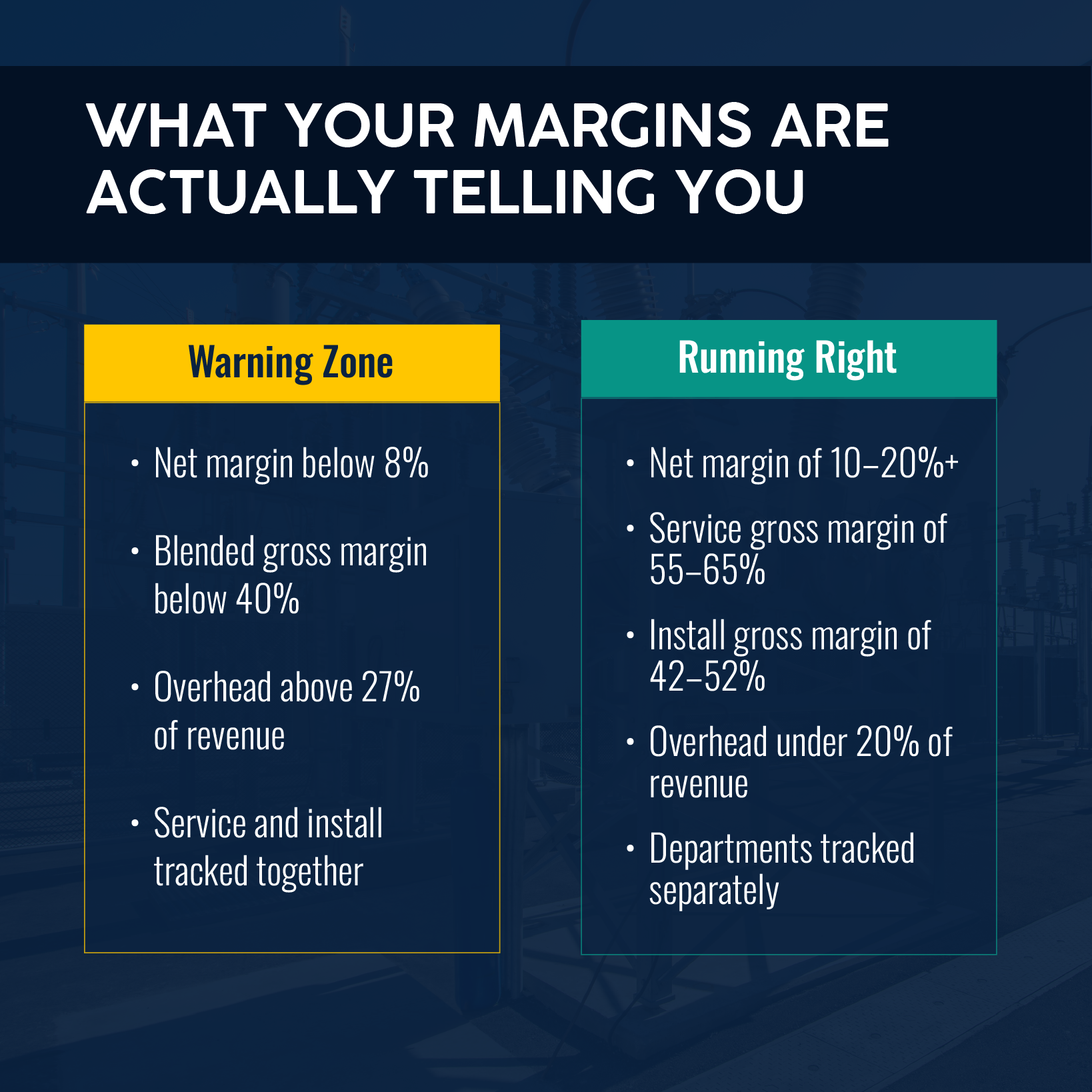
11. The industry-average net profit margin is 5–12%, but strategically run companies achieve 10–20%
The difference is usually related to overhead management and pricing discipline, not demand. If your net margin is sitting at 4%, the issue almost certainly isn't that you're not busy. It's that overhead is eating the work you're already doing.
Source: Profitability Partners
12. Service & repair targets 55–65% gross margin; replacement/install targets 42–52%
Don't just rely on high-level numbers, as blended margins hide what's actually working. Service calls and install jobs have fundamentally different cost structures. Tracking them separately tells you where you're leaving money on the table and where you're already running lean.
Source: Profitability Partners
13. HVAC contractors average 7% net profit with flat-rate pricing, but only 4% without
That 3-point gap compounds quickly at scale. On a $2 million operation, that's $60,000 in additional take-home annually, all resulting from a pricing structure change rather than chasing new work.
Source: ACCA/Farmington Consulting Group
14. Offering 4+ proposal options increases close rates by 10% and share of premium equipment sales from 26% to 42%
Most contractors default to good/better/best pricing. A study from the Air Conditioning Contractors of America Association found that a fourth option — such as financing, indoor air quality add-ons, or extended warranties — meaningfully changes the sales mix.
The jump from 26% to 42% premium sales on your existing volume affects your margin, not just your revenue.
Source: ACCA/Farmington Consulting Group
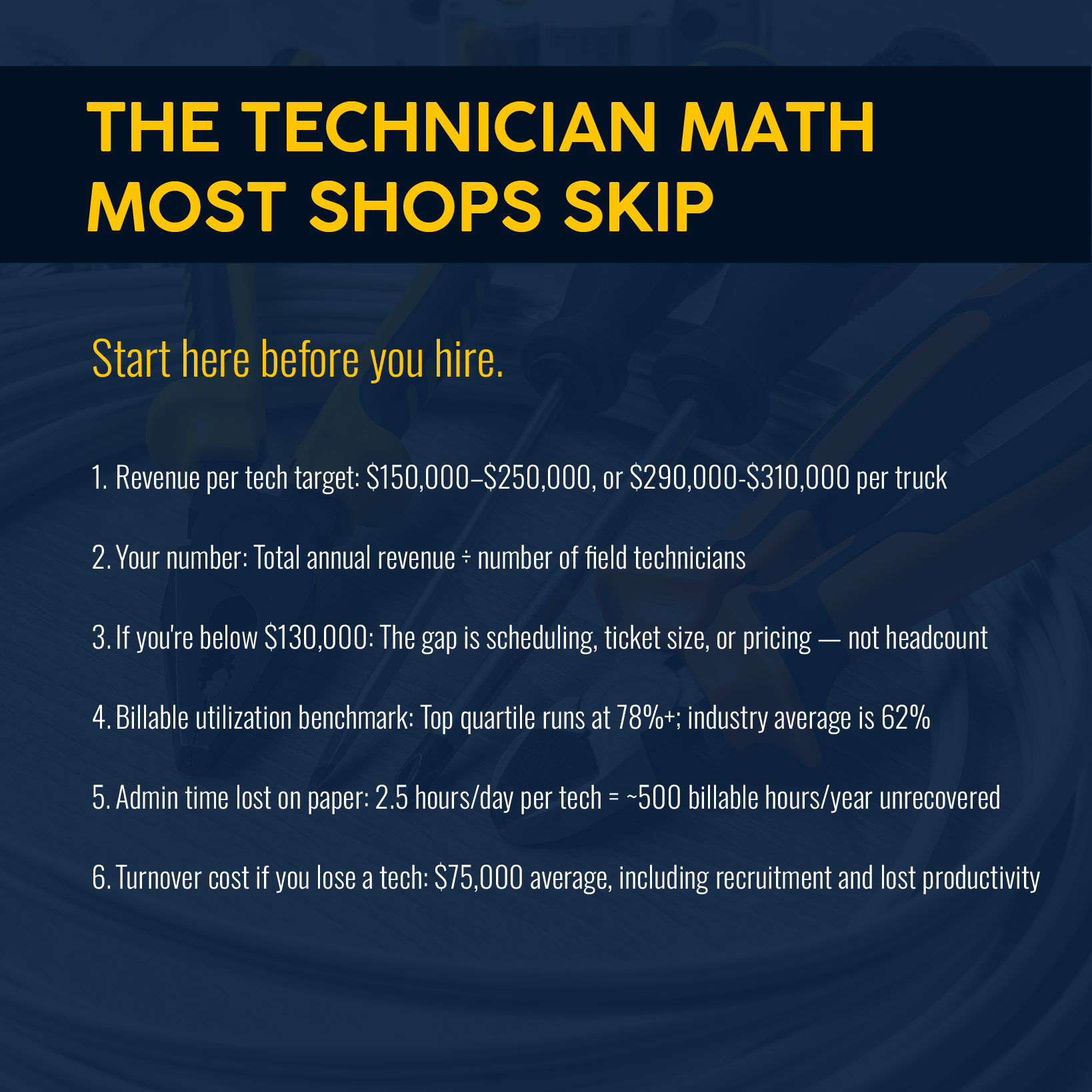
15. Revenue per technician ranges from $150,000–$250,000 annually; revenue per truck ranges from $290,000-$310,000
If your techs are averaging below $130,000, the gap almost always traces back to scheduling inefficiency, low average ticket, or underpricing. It's probably not about work ethic.
Another way to approach this is revenue per truck. The median is $290,000 for commercial and $310,000 for residential.
Related: Learn how to grow your HVAC business with tactics built for operations at scale.
16. Small and midsize HVAC companies typically report annual revenue of $500K–$2.5M; most average $500K–$1.25M
That range tells you something important about most HVAC business operators. Effective HVAC marketing, documented processes, and a functioning sales structure matter as much as technical competence, especially once you're past the startup phase.
The data reveals that execution, not demand, creates the gap between average and well-run operations.
Source: Therapeutic Tax Solutions
HVAC Repair, Replacement, and Customer Demand Statistics
Customer behavior and demand patterns shape how you price, staff, and schedule. These numbers show what clients actually expect.
17. The average residential HVAC service call ticket runs $75–$200; repairs run $150–$2,500+
Those ranges reflect labor rates, part costs, and complexity, not necessarily what you should be charging. A labor burden rate calculator can help you account for the full cost of labor, not just the wage you're paying the technician.
The average repair cost on a residential call varies widely by system type. Air conditioners, heat pumps, and ductless mini-splits each carry different profiles for parts and labor.
Commercial service calls can range from $150–$300 per call, with repairs often costlier than residential equivalents.
Source: Built on Tenth
18. Full HVAC unit replacement cost in 2026 runs $7,000–$15,000
The transition to higher-efficiency equipment has accelerated because of federal mandates and state-level rebates. As a result, the average ticket on replacement work is rising.
Contractors who can spec and install modern high-efficiency heating and air conditioning systems are capturing replacement work that less-prepared shops refer out.
Source: HVAC Load Calculate
19. 19% of homeowners will consider installing a new heating or AC system in 2026
That's not a small number. On a base of roughly 87 million owner-occupied households, that's roughly 16.5 million active consideration events in a single year.
Most of those won't convert without a contractor reaching them at the right moment with the right proposal.
Source: Carrier, via BDR; BLS via MacroTrends
20. Contractors spending 12+% of revenue on marketing see net profit rise from 5% to 9%
In 2026, the average cost per lead (CPL) for HVAC Google Ads is $104, although CPLs vary widely depending on format.
Most shops underspend on marketing relative to what the data supports. The ACCA study shows this gap persisting across company sizes.
Source: ACCA/Farmington Consulting Group; SearchLight Digital
HVAC Technology and Automation Statistics
Technology adoption is widening the performance gap between digitized shops and those still running on paper. Here are numbers illustrating the gap — and the opportunity in closing it.
21. 56% of HVACR contractors have FSM software, but most use it primarily for invoicing
Most of the software value is going unused. Scheduling optimization, inventory management, quoting, and financial reporting are where the operational leverage lives, not invoicing.
The ROI potential is massive: 94% of companies adopting FSM software report significant productivity gains.
Source: ACCA/Farmington Consulting Group; Simpro 2025 Trades Outlook Report
22. HVAC software can reduce time per task by 24% and give workers back more than 20% of their weekly hours
Whether it's better scheduling, faster invoicing, or route optimization, HVAC contractors can not only save time but also be more efficient. They recover billable time, reduce overtime, and cut the error-handling costs that eat into margin on every job.
Source: ACHR News
23. 31% of technician time is spent on nonproductive activities such as paperwork and waiting for parts
That's not a staffing problem. It's a systems problem. Add in travel, and 53% of paid tech time isn't generating revenue. For many HVAC businesses, your billable utilization is materially worse than your headcount suggests.
Source: Oxmaint
24. Offering financing on every job finances 35% of sales versus 17% for selective offers; close rates increase 11%
Only 28% of surveyed contractors offer monthly payment options, with most still defaulting to total price. The contractors presenting payment-first close more jobs at higher ticket sizes.
Customers don't choose financing because they can't afford the work, but because monthly payments remove the sticker shock — and encourage them to say yes.
Source: ACCA/Farmington Consulting Group
Related: See how AI is helping HVAC companies protect margins and revenue in 2026.
HVAC Regulation, Refrigerant, and Energy Efficiency Statistics
The R-410A phase-out is the most immediate regulatory pressure for working contractors in 2026. These numbers show the scope of the transition.
25. 42% of U.S. households have now transitioned to electrical heating systems
Federal tax credits and state-level rebates have accelerated heat pump adoption. The North America heat pump market totaled $20.48 billion in 2025 and is expected to grow over the next several years.
Contractors that can install heat pumps could capture a growing share of residential replacement demand, particularly as cooling and heating systems reach the end of their useful lives.
Sources: U.S. Energy Information Administration, MMR Statistics
26. 63% of HVAC customers prioritize savings when buying energy-efficient systems
Just because money is a primary driver doesn't mean consumers don't also care about the environment and their carbon footprint. This same survey noted that 58% consider sustainability "very important" or "extremely important" in their decisions.
The premium-tier upsell is now aligned with what customers actually want, which makes the four-option proposal structure more effective than it's ever been. Make sure customers know about any rebates and incentives that are available.
Source: Aux
27. Upgrading to energy-efficient HVAC systems can reduce energy consumption by 50–65%
Those are the numbers that clients care about when you're presenting options. The benefits span all seasons, with energy savings possible from high-efficiency air conditioners and heat pump water heaters, for example.
Contractors who lead with efficiency savings close at higher ticket sizes.
Source: U.S. Department of Energy
HVAC M&A and Valuation Statistics
Private equity consolidation has accelerated sharply. These numbers matter whether you're thinking about an exit or just trying to understand what your business is worth and what drives that value.
28. Private equity participation in HVAC deals grew from 8% in 2023 to 23% in 2024
Buyer demand for HVAC companies within Axial's network grew 550% between 2020 and 2023. The consolidation wave is still rolling.
Source: Axial
29. PE firms completed 32 add-on HVAC acquisitions in the first half of 2025, up 88% from a year earlier
In addition, over 55% of all global HVAC M&A transactions during that period were PE-backed. The residential services segment is midway through its consolidation cycle, while the commercial segment is still in early stages. For operators that want to position themselves for acquisition, the window is still open.
Sources: S&P Global Market Intelligence
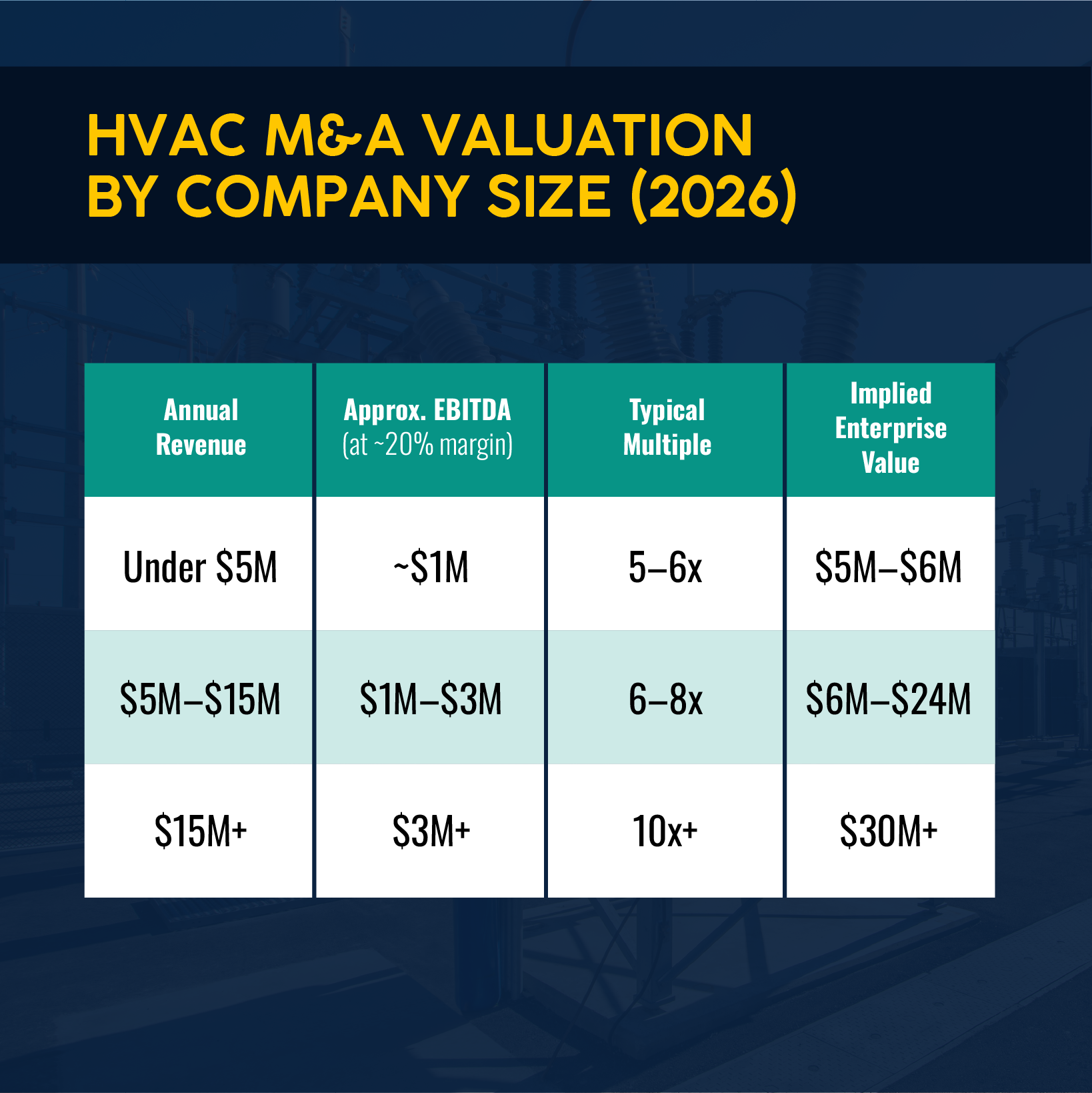
30. EBITDA valuations for HVAC companies average 8x
Top performers can get even higher multiples. Make sure you understand what drives multiple expansion: recurring revenue mix, management depth, clean financials, and EBITDA scale. Your day-to-day operational decisions can translate directly into exit value.
Sources: Western Commerce Group
| Revenue | Approx. EBITDA | Typical Multiple | Implied Enterprise Value |
|---|---|---|---|
| Under $5M | ~$1M | 5–6x | $5M–$6M |
| $5M–$15M | $1M–$3M | 6–8x | $6M–$24M |
| $15M+ | $3M+ | 10x+ | $30M+ |
Source: Profitability Partners
What These HVAC Statistics Mean for Contractors in 2026
The data above points to the same conclusion from multiple directions:
- The market is growing. Replacement demand, energy mandates, electrification, and commercial growth are all positive signals. The constraint is execution, not demand.
- The labor shortage is structural. 110,000+ vacancies and a graying workforce aren't going to self-correct. Retention, training, and workflow efficiency are competitive advantages.
- The margin gap is mostly operational. The difference between a 4% net margin and 15–20% isn't more jobs. It's pricing structure, overhead control, departmental tracking, and job costing.
- Software ownership and software utilization are not the same thing. 56% of contractors have FSM software. Most of them don't get the full value.
- Valuation math rewards operational discipline. Clean financials, recurring revenue, and EBITDA scale are what move multiples. Operators who build these systems give themselves the opportunity to exit on their terms.
The Businesses That Win in 2026 Are Already Running Tighter Than Their Competitors
The HVAC market in 2026 is large, growing, and being consolidated by buyers who understand exactly what a well-run operation is worth. The businesses capturing the best margins, the best valuations, and the best technicians aren't doing fundamentally different work. They're running it better.
Simpro® is built for exactly that. Across 24,000+ trade businesses, the platform handles scheduling, dispatching, quoting, job costing, and reporting in one system, giving you the operational visibility to manage by KPI instead of by gut feel. Contractors using Simpro report up to a 30% productivity increase and, in some cases, 25% revenue growth.
Ready to see what running a tighter shop actually looks like for your numbers? Schedule a demo.
FAQs About HVAC Industry Statistics 2026
What's driving HVAC industry growth?
Climate-driven demand for cooling, federal and state energy-efficiency mandates, aging infrastructure requiring replacement, and new commercial construction are all contributing. The refrigerant transition from R-410A to A2L refrigerants is also creating replacement demand as older equipment reaches end-of-service. These HVAC industry trends point to sustained growth well beyond 2026.
Is there still a shortage of HVAC technicians?
Yes, and it's getting worse, not better. The industry currently has approximately 110,000 vacant technician positions, with 40,000 new openings coming onto the market annually. Contractors can reduce retention fears and improve operational efficiency by investing in their current technicians.
Why do HVAC statistics vary by source?
Market=size estimates vary depending on the scope. Some figures count only equipment; others include services, maintenance, software, and adjacent categories. Research firms also use different CAGR models and base year assumptions. For contractors, the most actionable HVAC KPIs are the operational benchmarks: margins, revenue per tech, and first-time fix rates, where the data is more consistent because it traces back to real P&Ls and industry studies.
How can HVAC businesses use industry statistics?
The most useful application is as a diagnostic baseline. If your revenue per technician trails the industry range of $150,000–$250,000, it's usually a problem with scheduling, ticket size, or pricing. If your net margin is 5% against a best-in-class benchmark of 15–20%, the spread is almost always overhead management and pricing structure. Industry statistics tell you where to look; your P&L tells you what you're dealing with.
Related: Not running a business of your own yet? Here's how to start an HVAC business with a solid operational foundation from day one.


 Back to top